
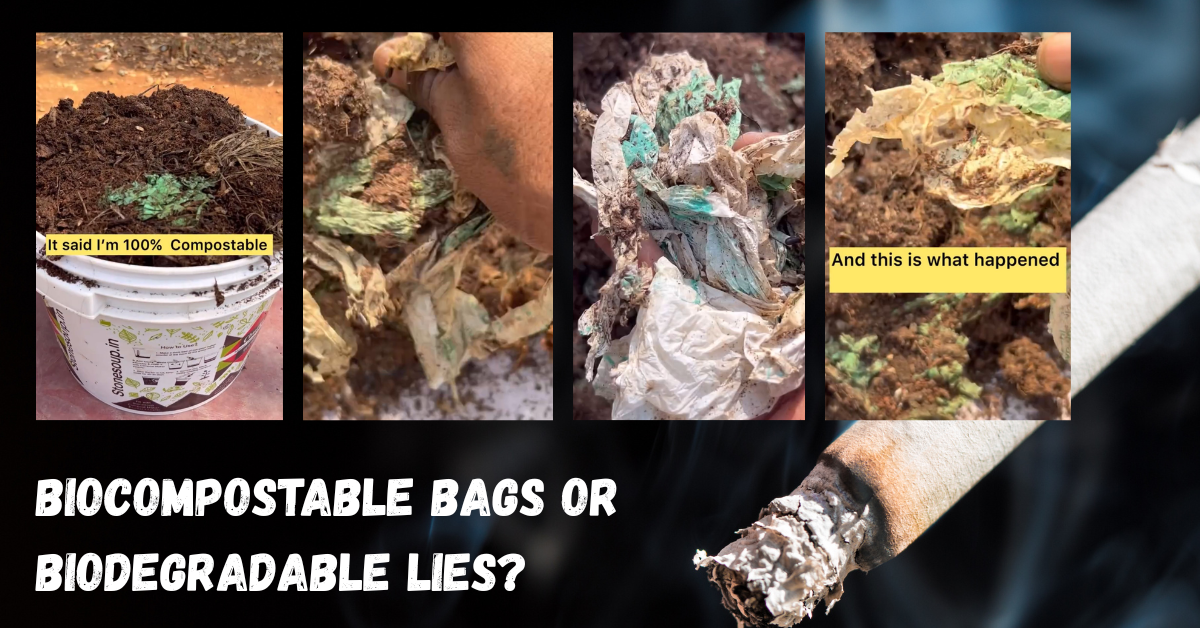
Anyone who has studied these so-called ‘eco-bags’ for years and observed keenly how well they ‘biodegrade’ can confidently say that consumers are being sold the environmental equivalent of light cigarettes: still harmful, still carcinogenic, but with better marketing.
Can you recall how tobacco companies convinced millions that ‘light’ cigarettes were safer? Same scientific-sounding terms, same false sense of security, same devastating results. Today’s plastic industry seems to have borrowed that playbook perfectly, but with a cruel twist: they’re targeting people who specifically want to avoid plastic.
Think this through:
- Biodegradable has now become the new light.
- Compostable is the new filtered.
- Eco-friendly is the new reduced tar.
Different industry, same manipulation. Let me explain why.
Biodegradable lies
Not just me, I know several of my friends who tested bio-compostable bags by composting them at home for 6-8 months and saw them come out stubbornly intact, mocking every claim on their fancy green labels. Only their size shrunk slightly, very much like those deflated promises. These tests began sometime in 2012-13 and till now, there hasn’t been a single successful and replicable example of one person or community that has been able to compost these bags, not even a small percentage of the total numbers of bags used and discarded.
The real eye-opener comes when you look around Bengaluru during monsoon season. These ‘eco-bags’, along with regular plastic bags and polypropylene bags, have turned our storm drains into plastic graveyards. Years of accumulated biodegradable lies are choking our drainage systems, breeding disease, and poisoning our air.
Just like light cigarettes still caused cancer, these green bags still clog drains. After all, the drains weren’t designed for bags that lie about decomposing. To top it off, we have heard claims that these bags take six months to compost.
Six months to decompose? That’s not composting, that’s procrastination!
Consumer confusion
Here’s where the deception gets truly sinister. With regular plastic bags, we know exactly what we are getting and hence, can avoid them if we choose to. The last time I checked, we had 13 different types of bioplastics flooding the market, each with different requirements, different disposal methods, and different degrees of harm.
Even people like us struggle to tell them apart simply because of the confusion created. Some need commercial composters at high temperatures. Others leave toxic residues. Many work only under perfect laboratory conditions.
Dig a little deeper and you will know consumer confusion isn’t a bug in their system. It’s a feature! The plastic industry has made avoiding plastic bags nearly impossible by disguising them as eco-friendly alternatives.
Just like it worked with the cigarette industry for long, the plastic industry is also banking on this confusion. The hidden agenda is clear: the more complicated the label, the easier it is to fool people.
Thank you for smoking
If you have watched this 2005 movie, you would know about the satirical route it took. Aaron Eckhart plays Nick Naylor, a suave spokesperson who can spin any argument in favour of cigarettes.
At one point, he says: “I don’t have to prove that cigarettes are safe. I just have to prove that you’re wrong to say they’re dangerous.”
That line sums up the industry’s strategy: muddy the waters, create doubt, and shift the burden of proof onto critics.
Then what are we supposed to do? Just like with cigarettes, the only real solution when it comes to these ‘eco-bags’ is to quit entirely.
The pictures embedded in the graphic came from the Swachagraha Kalika Kendra team, Bangalore.
For more details, read: Which works better & safer? Biodegradable bags or bio-compostable bags? The answer: Neither.

 ENDLESSLY GREEN
I have also tried the experiment and concur with your verdict – biodegradable bags don’t biodegrade!
LikeLiked by 1 person